
This sample set is produced by VOXUS Virtual Organs.
The price for the 6-channel surround set is 119 EUR (141,61 EUR incl. German VAT).
For customers outside the European Union the VAT will be deducted.
Note: The Jacobikerk Uithuizen Surround sample set is compatible with Hauptwerk™ version V or later.
The Organ of the Jacobikerk in Uithuizen
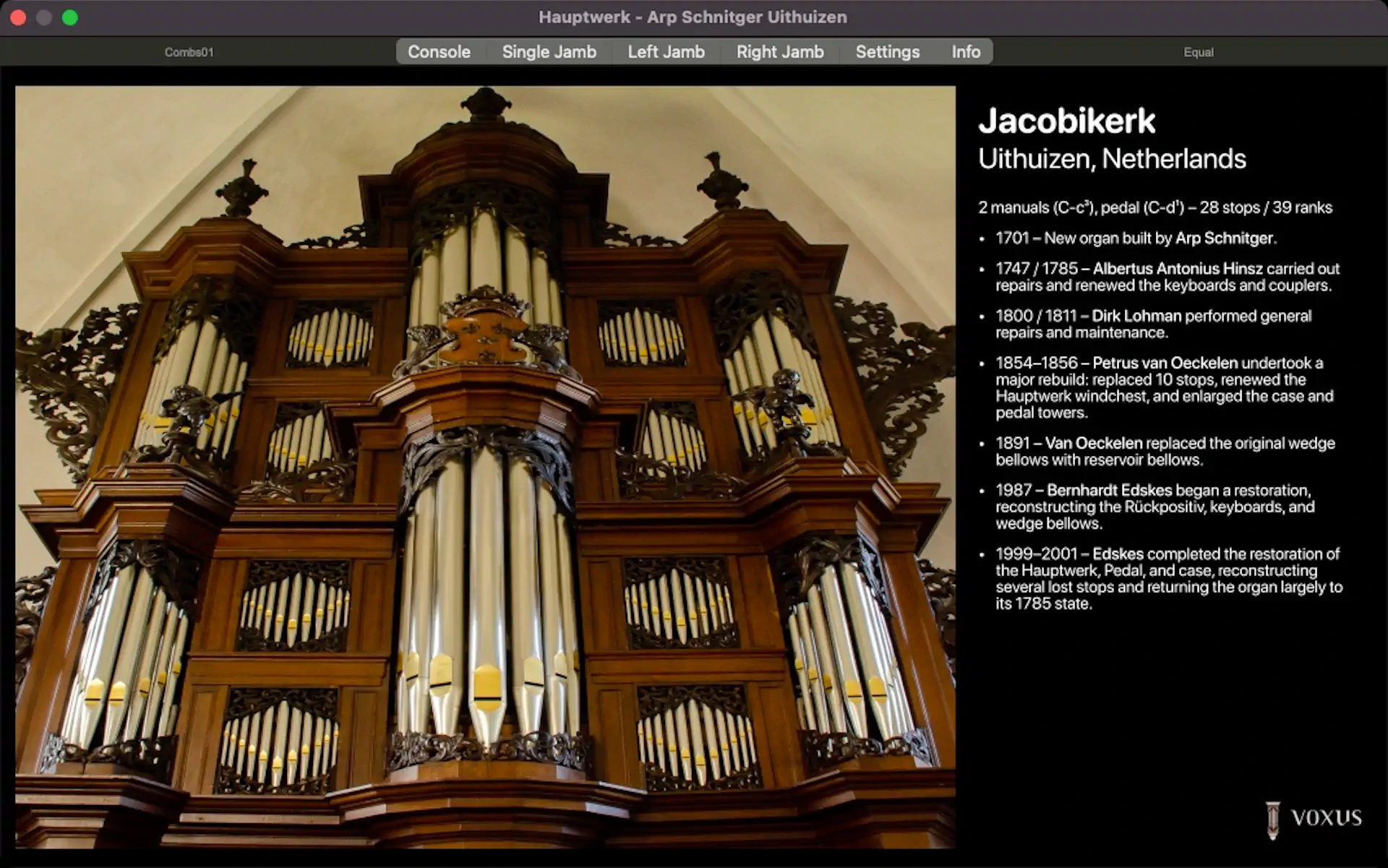
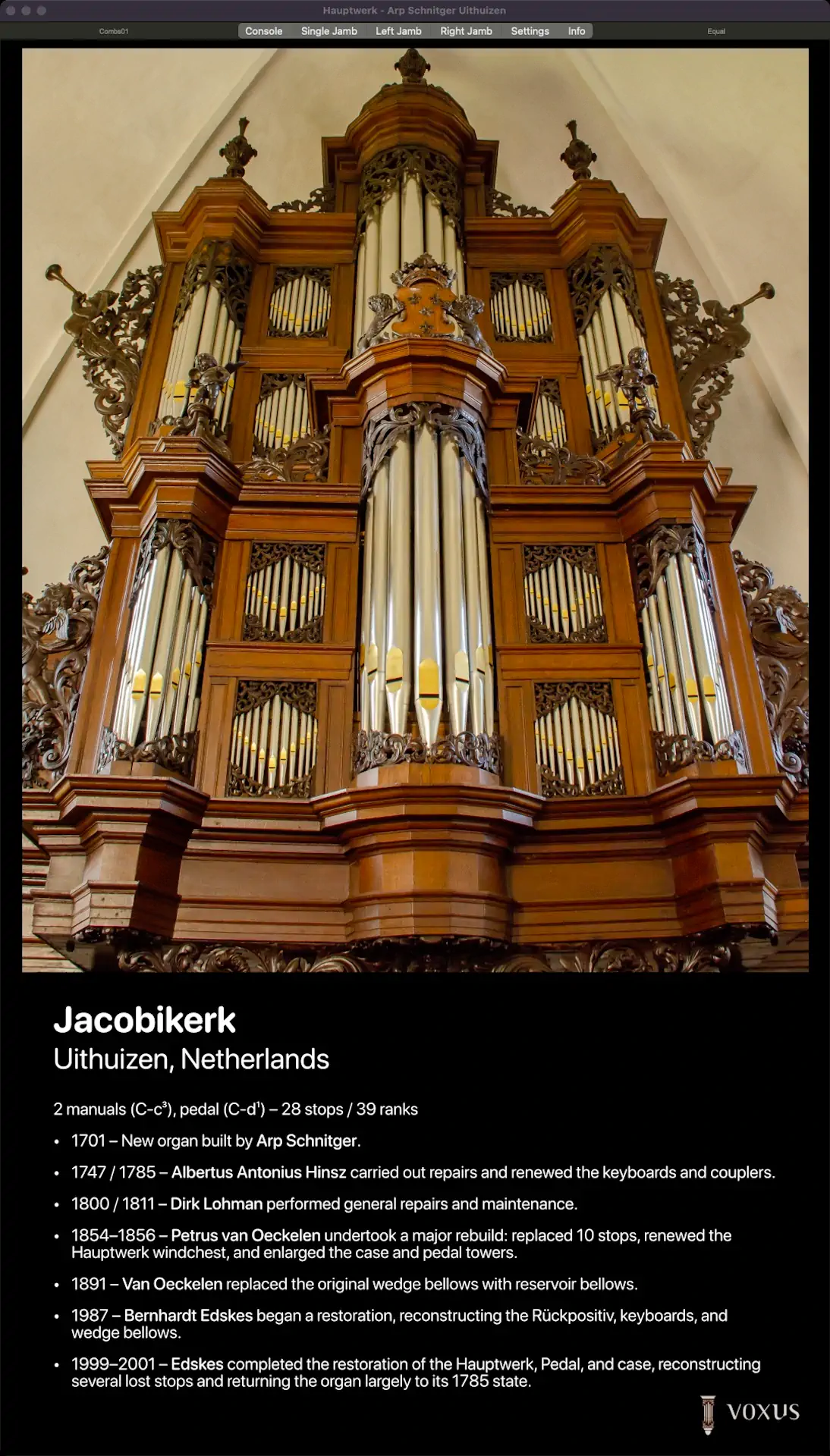
The organ of the Jacobikerk in Uithuizen, located in the Dutch province of Groningen, is one of the finest and best-preserved instruments created by the renowned organ builder Arp Schnitger. Completed in 1701, the organ has 28 stops distributed across two manuals and pedal, and is regarded as a masterpiece of the North German Baroque tradition. Its exceptional state of preservation has made it an important reference point for twentieth-century organ building and for the reconstruction of lost stops in other Schnitger instruments.
Although documentary evidence indicates that an earlier organ existed in the church during the seventeenth century, Schnitger did not reuse any material from the predecessor instrument. In 1699, the church council commissioned him to build an entirely new organ with 27 stops. During construction, Schnitger added an extra stop at his own expense, resulting in the present specification of 28 stops. At the time of its completion, the organ was the largest village church organ in the Netherlands.
The magnificent case was designed and built by cabinetmaker Allert Meijer and is considered one of the finest examples of Dutch Baroque organ architecture. Both the Manuael and the Rughposityf are arranged in five sections, crowned by an elevated central tower and flanked by trapezoidal side towers—an unusual feature in Schnitger’s work, as he more commonly employed pointed side towers. Richly carved acanthus ornamentation, elegant scrollwork and musical angel figures adorn the façade. The coat of arms of the noble Alberda van Menkema family rises above the central tower of the Rückpositiv, reflecting the patronage that supported the instrument’s creation.
Over the centuries, the organ underwent several repairs and modifications. The organ builder Albertus Antonius Hinsz carried out important maintenance in 1747 and 1785 while carefully preserving Schnitger’s tonal concept. More extensive alterations followed in the nineteenth century, particularly under Petrus van Oeckelen, who replaced a number of stops and modified parts of the wind system and casework.
A comprehensive restoration campaign returned the organ to its original character. Under the direction of Bernhardt Edskes, the Rughposityf was restored in 1987, followed by the Manuael and Pedael between 1999 and 2001. Lost stops, wedge bellows and keyboards were meticulously reconstructed using surviving historical material and detailed research.
Today, the organ of the Jacobikerk stands as one of the most important surviving works of Arp Schnitger and remains an outstanding monument of European organ culture.
Stop List
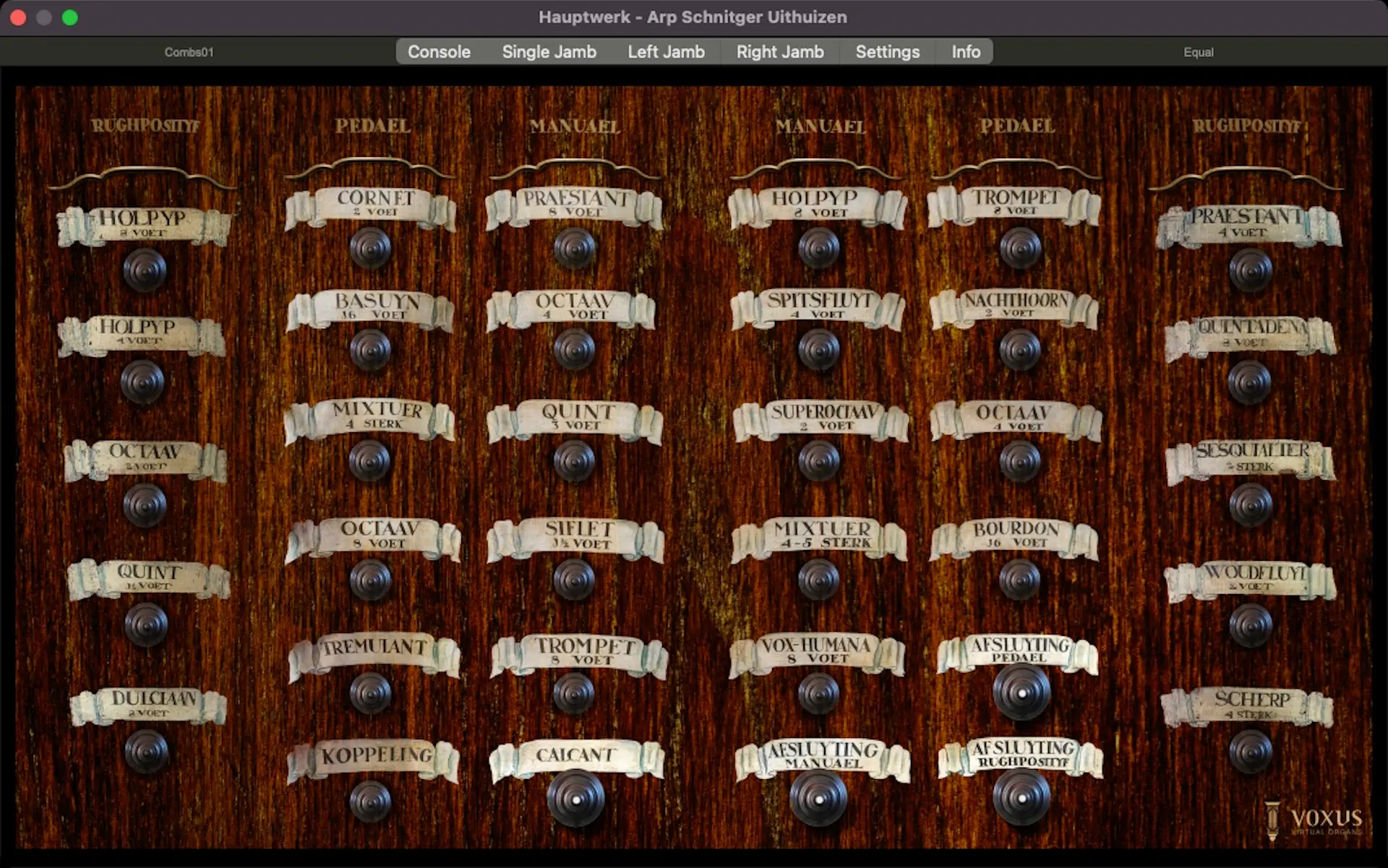
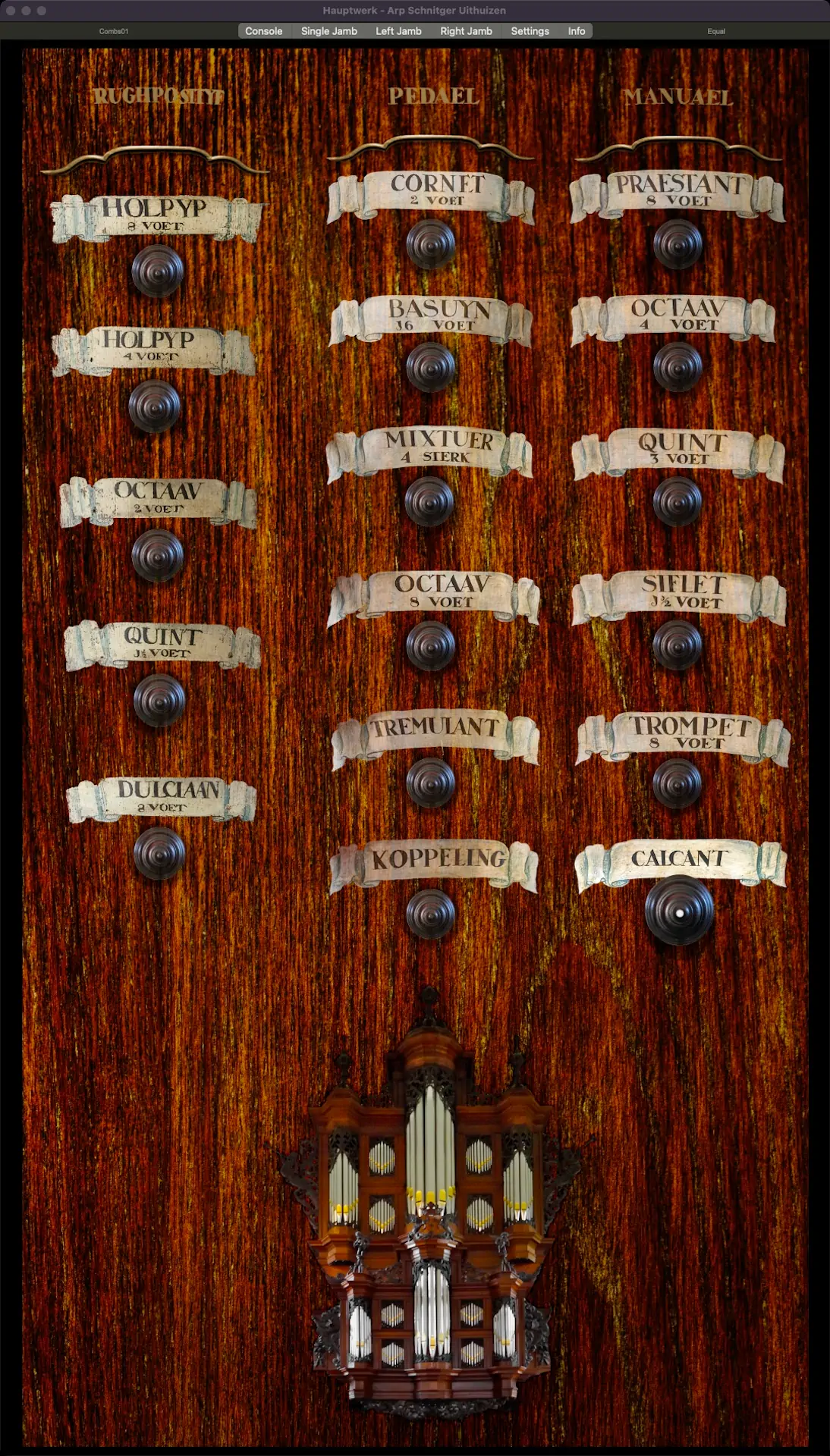
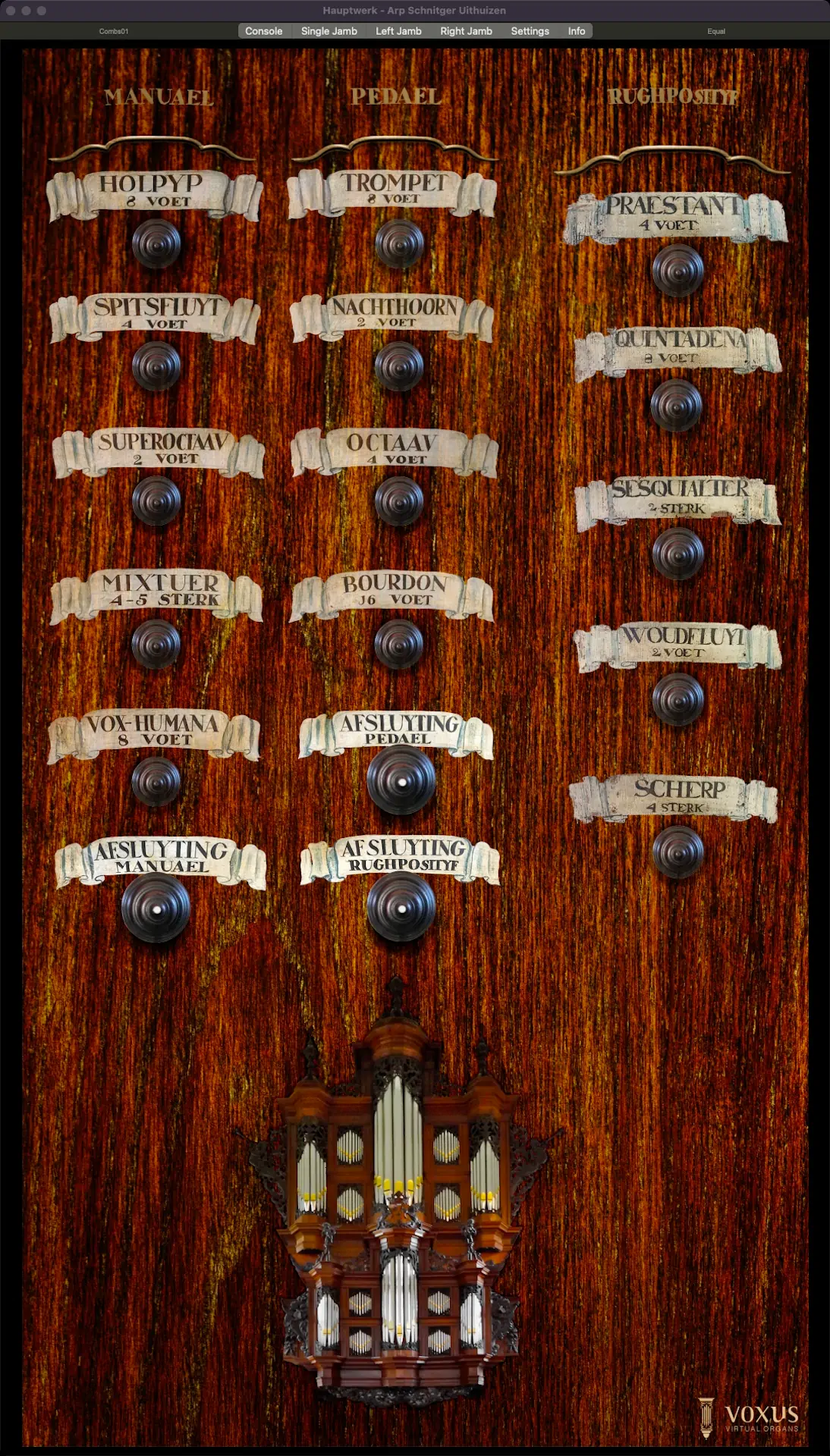
I. Manuael
Prestant 8′ (E)
Holpyp 8′ (S)
Oktaav 4′ (S)
Spitsfluyt 4′ (S)
Quint 3′ (S)
Superoctaav 2′ (S/E)
Siflet 1 1/2′ (S/E)
Mixtuer IV–V (S)
Trompet 8′ (E)
Vox humana 8′ (S)
II. Rughposityf
Praestant 4′ (S/E)
Holpyp 8′ (S)
Quintadena 8′) (S/E)
Holpyp 4′ (S)
Octaav 2′ (S/E)
Woudfluyt 2′ (S)
Quint 1 1/2′ (S)
Sesquialter II (S)
Scherp IV (E)
Dulciaan 8′ (S)
P. Pedael
Compass
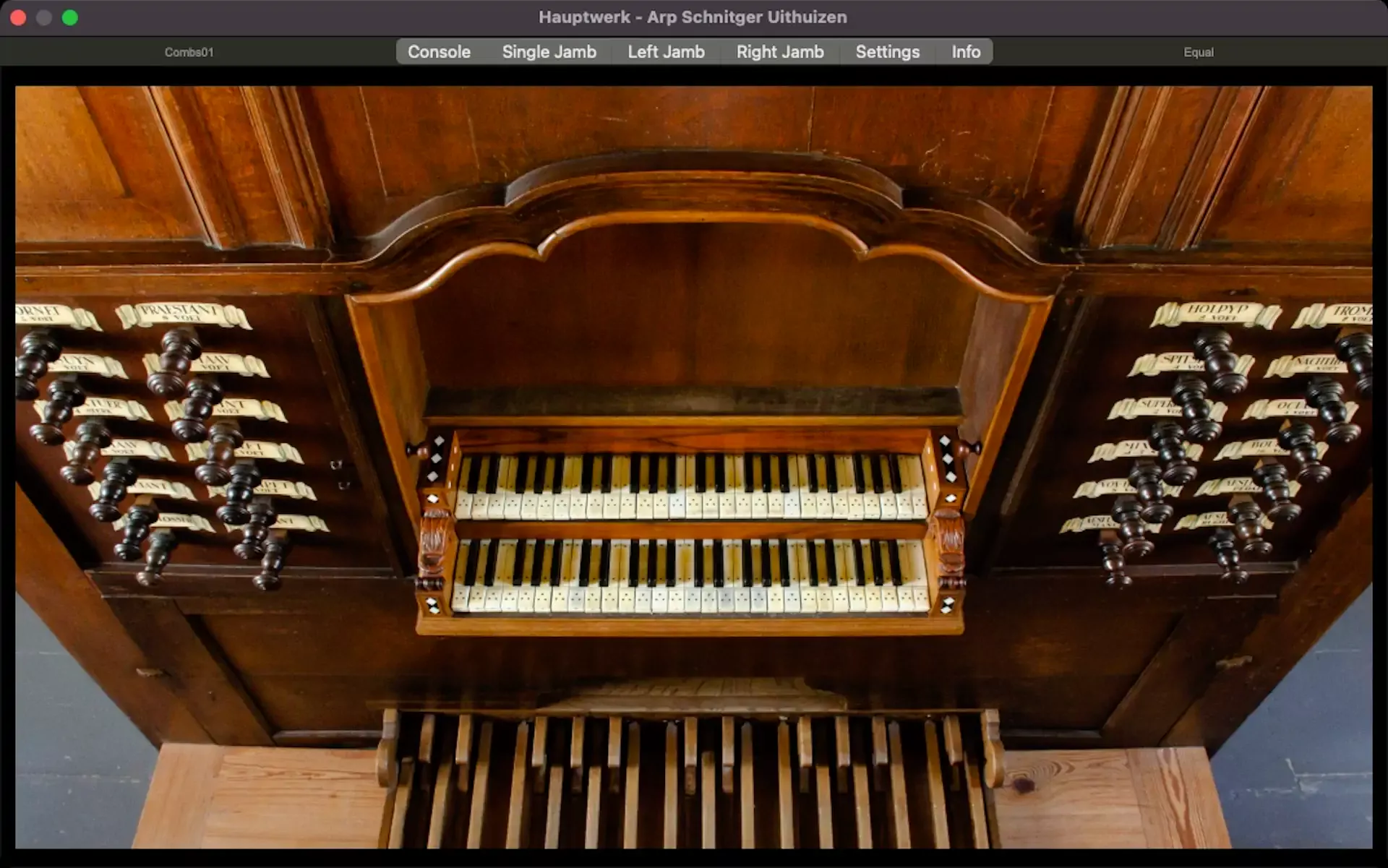
Manual I compass: C – c³ (Hauptwerk extension: C – f³)
Manual II compass: C – c³ (Hauptwerk extension: C – f³)
Pedal compass: C – d¹ (Hauptwerk extension: C – f¹)
Couplers
Sliding coupler II/I
Accessories
Tremulant (affects the whole organ)
Tremulants for the individual divisions (Hauptwerk extension)
Calcant
Windlosser
Comments
S = Arp Schnitger (1701)
E = Bernhard Edskes (1987/2001)
Sample Set
- Six channels (3 stereo channels) of chromatically sampled stop-by-stop pipes
- Recorded tremulants for all stops
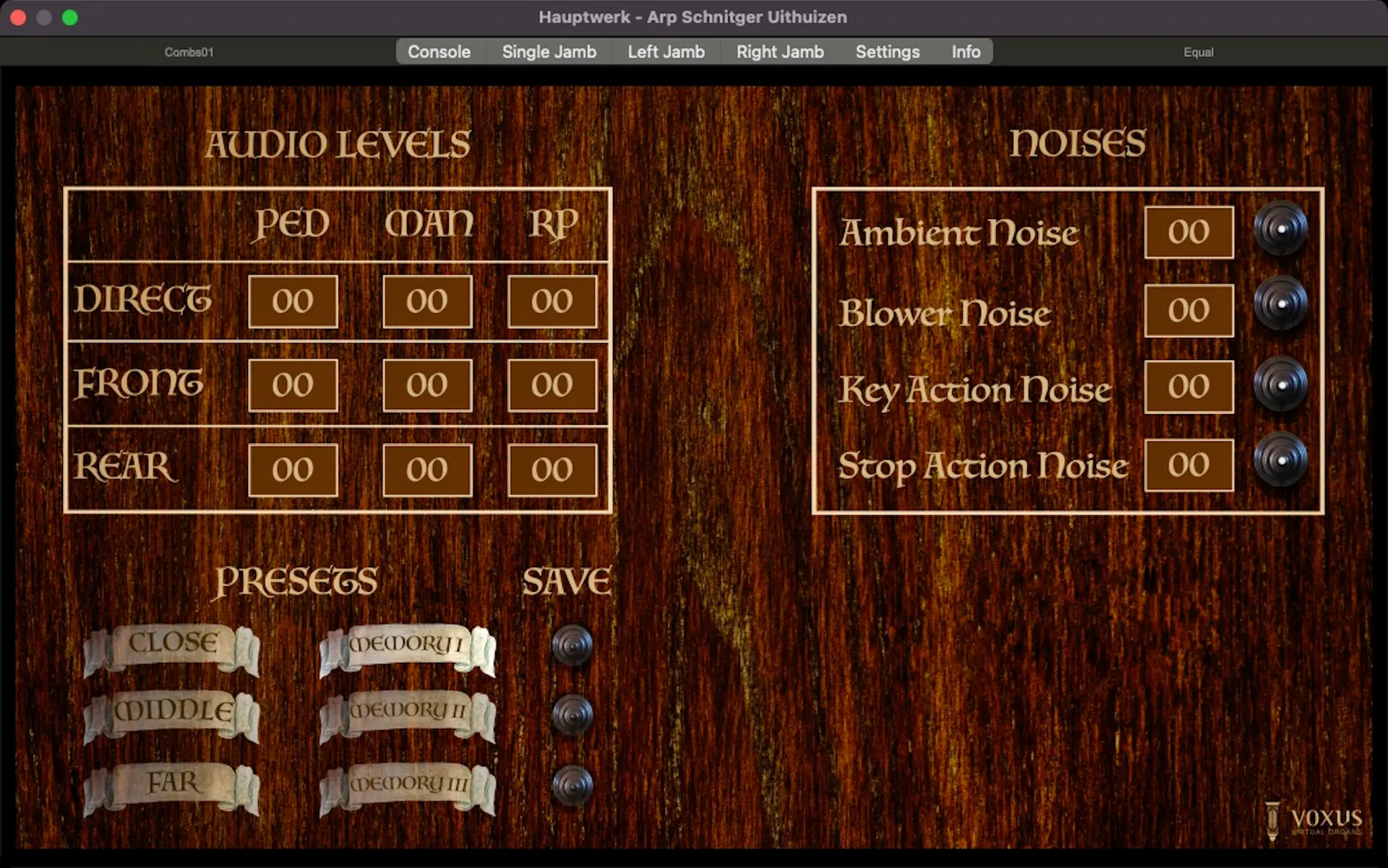
- Adjustable volume levels for each division and perspective
- Adjustable volume levels for ambient, blower, key action and stop action noises
- 3 fixed (Close, Middle, Far) and 3 custom volume presets
- Photorealistic console screen (landscape)
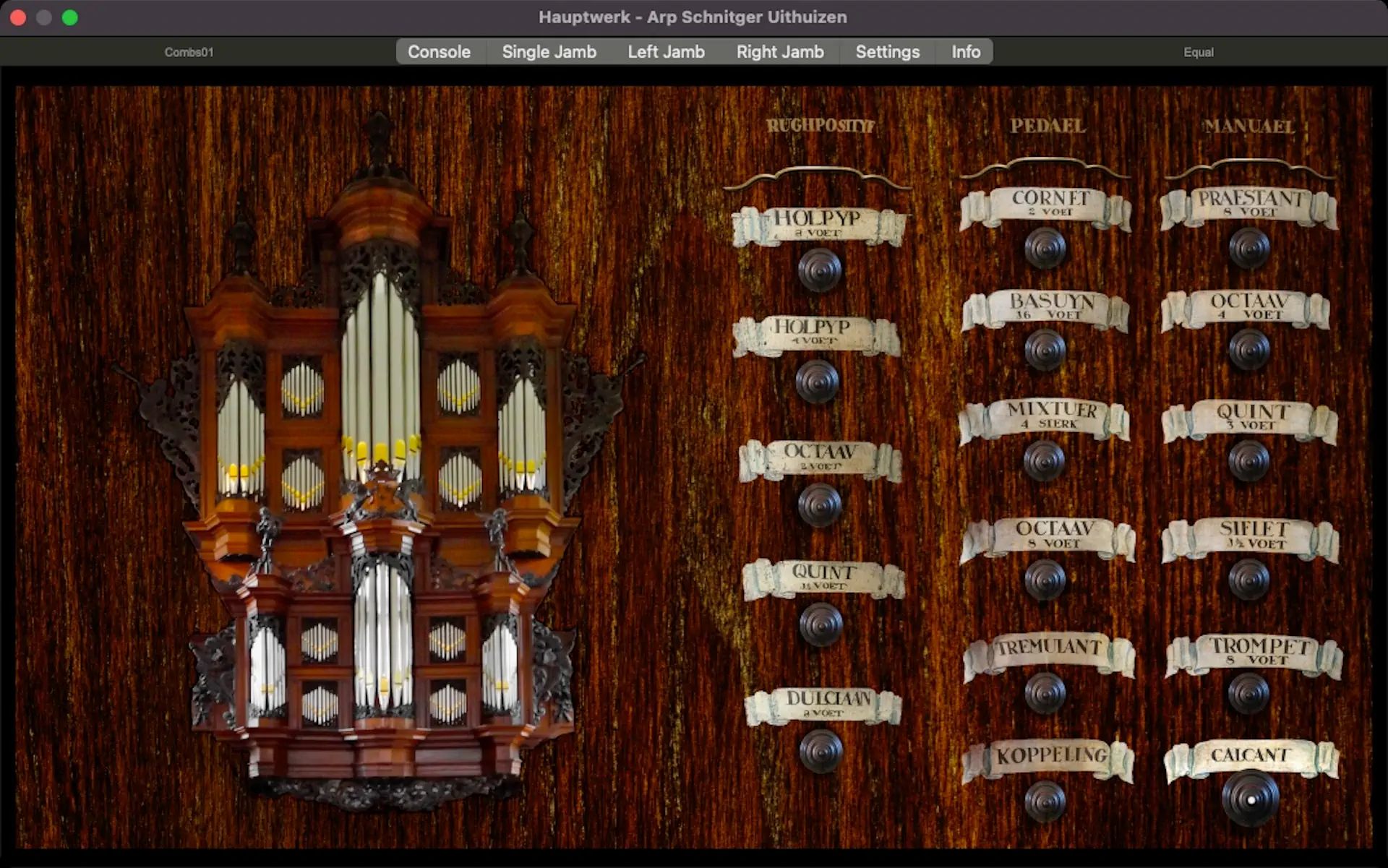
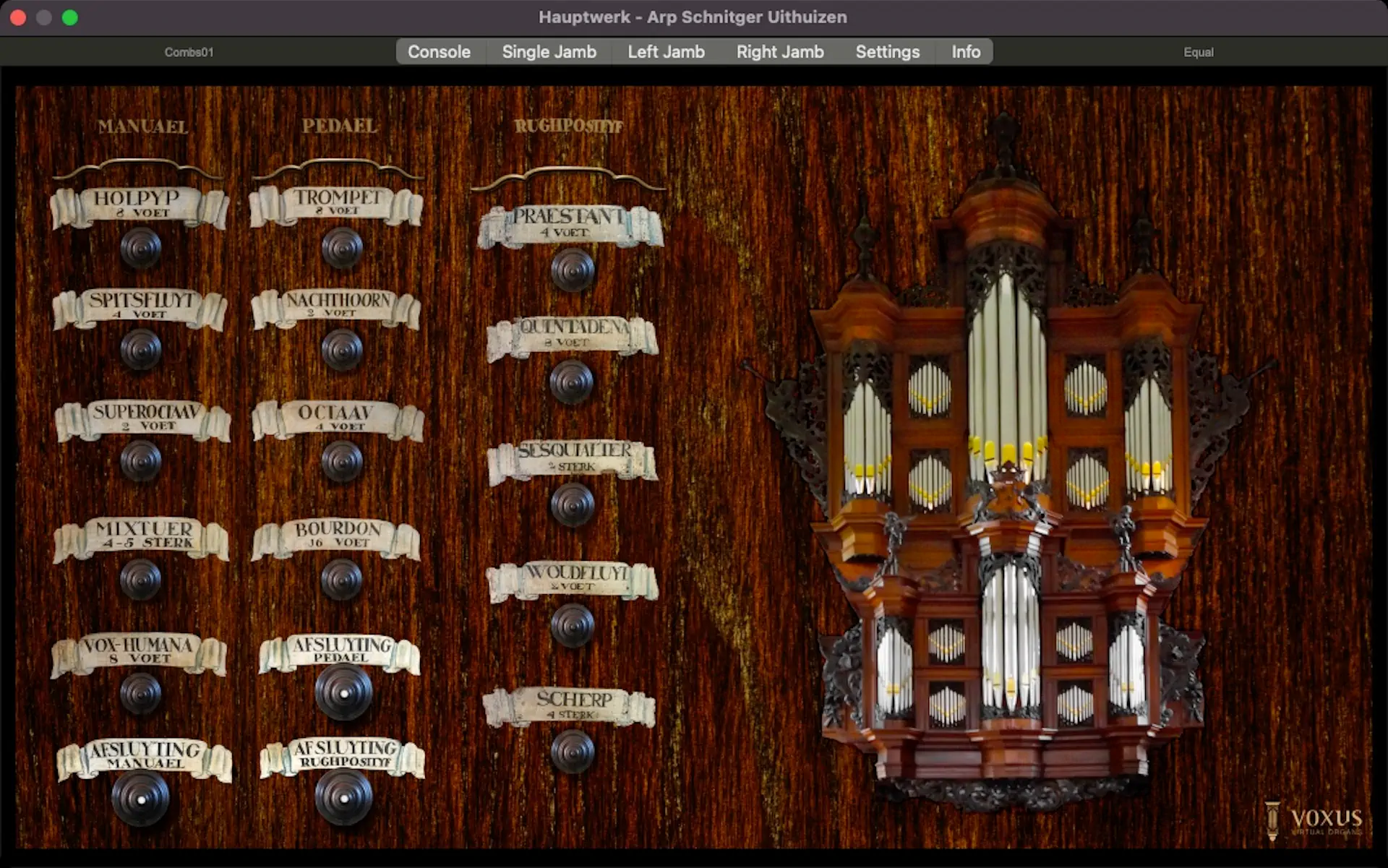
- Photorealistic single jamb (landscape)
- Photorealistic dual jambs (landscape and portrait)
- Settings screen (landscape)
- Info screen (landscape and portrait)
RAM Requirements
6 channels, 24-bit lossless compression, multiple audio loops: 30.7 GB
6 channels, 20-bit lossless compression, multiple audio loops: 28.0 GB
6 channels, 16-bit lossless compression, multiple audio loops: 15.9 GB
Screenshots
Contrebombarde
Ralph Looij
Gorg Böhm: 8 Partitas on “Ach wie flüchtig, ach wie nichtig”
YouTube
N.N.
N.N: …
